The Hybrid Operation
by Saša Cibula
The Management System for Human–AI Work
Book One of The Management Systems Trilogy
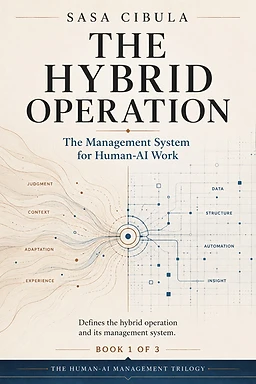
Defines the new human–AI operating environment and the management system required to run it — treating automation as a redesign of work, roles, standards, and control rather than a technology installation.
The Hybrid Operation defines the new human–AI operating environment and the management system required to run it. It treats automation not as a technology installation but as a redesign of work, roles, standards, and control — the foundation of the Management Systems trilogy.
The book argues that organizations do not have an AI problem. They have an operating-model problem made visible by AI. Most companies can automate tasks. Far fewer have built the management system that turns automation into enterprise results — the kind that shows up in cycle time, working capital, service, and return on invested capital rather than in pilot counts.
Editions
Who this is for
If you have an AI problem that is really an operating-model problem, this book is for you.
Operations and technology leaders responsible for integrating AI into the operating model.
Executives who need the system, not just the tools, to deliver enterprise results.
Inside the book
The New Operating Environment
Why AI changes the operating model rather than merely the workflow — and what that means for how roles are defined, how standards are set, and where control over outcomes must sit when work is shared between people and machines.
Manage the System
The management system required to run human–AI work at enterprise scale — the cadences that keep it aligned, the decision rights that keep it clear, the measures that keep it honest, and the accountability that keeps it real.
The Foundation of the Trilogy
How this book sets up the two that follow: Human–AI Fusion, which explains how to combine the capabilities, and Modern Workplace Accountability, which defines who owns the result. The trilogy's arc is simple — manage the system, combine the capabilities, own the result.
From the book“You do not have an AI problem. You have an operating-model problem that AI has made impossible to ignore.”
Why it matters
Most companies can automate tasks. Far fewer have built the management system that turns automation into enterprise results. Without that system, AI pilots stay pilots — promising in isolation, invisible in the metrics that actually run the business. This book is the foundation for closing that gap.
Key ideas
- Organizations do not have an AI problem — they have an operating-model problem made visible by AI.
- Automation is a redesign of work, roles, standards, and control, not a technology installation.
- The management system — cadences, decision rights, measures, accountability — is what turns automation into results.
- Results must show up in cycle time, working capital, service, and return on invested capital, not in pilot counts.
Related briefings
The Verdict
You do not have an AI problem. You have an operating-model problem made visible by AI. This book defines that environment and the management system required to run it — the cadences, decision rights, measures, and accountability that turn automation into enterprise results. Without that system, pilots stay pilots.